Street Photography Tips: A Working Photographer's Field Guide
Photo Culture · 8 October 2024
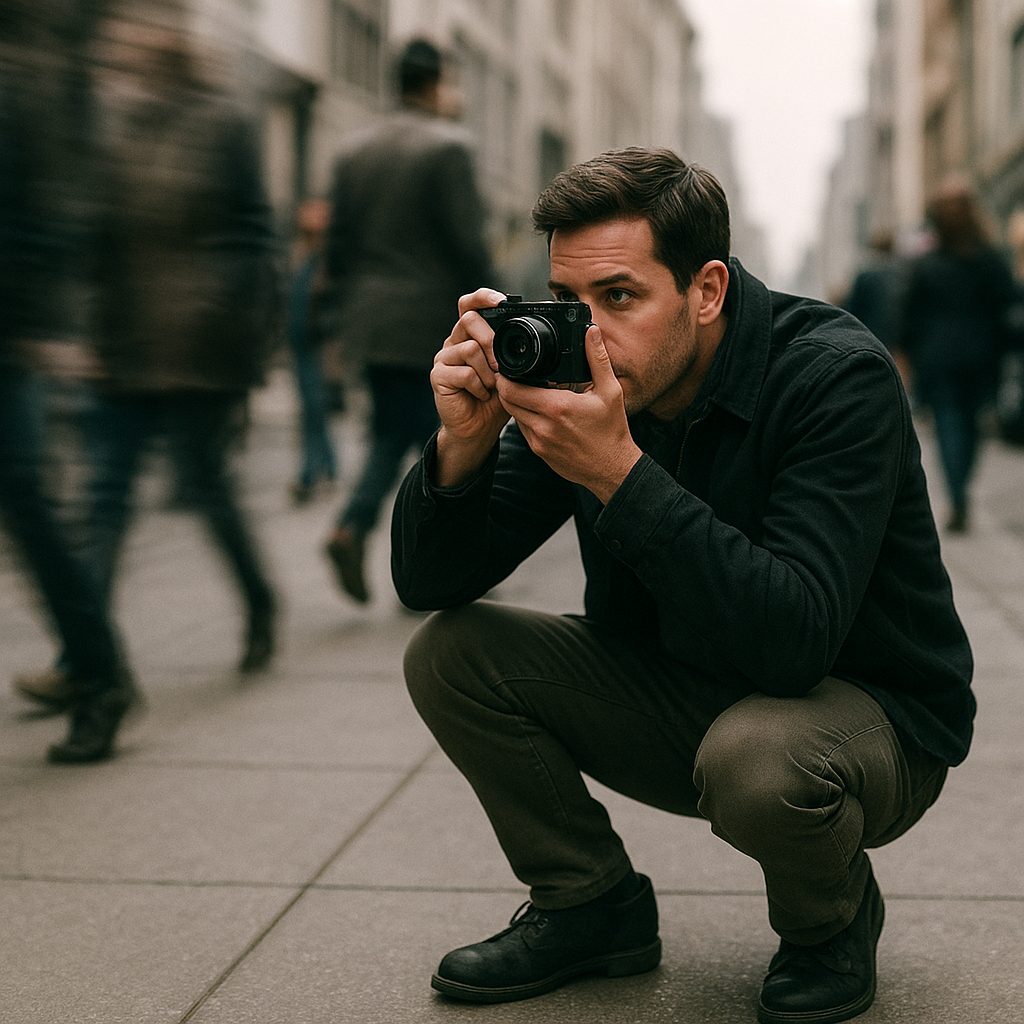
Street photography has the lowest barrier to entry of any genre — a camera, a pavement, an afternoon — and the highest failure rate. Most frames are nothing. The gap between photographers who occasionally get lucky and photographers who come home with something most days is not talent; it is a set of working habits. These are the street photography tips that actually move your hit rate, learned the slow way.
Set the camera once, then forget it
Fiddling is the enemy. Decide your exposure strategy at home and make it boring: aperture priority or manual with auto ISO, a minimum shutter speed that freezes walking people — 1/250th at least, 1/500th in good light — and an aperture that buys you forgiveness, f/5.6 or f/8. Learn your lens's depth of field at those settings until you can feel where the focus plane sits without looking. Many street photographers zone-focus: pre-set the focus to three metres, stop down, and everything from two to five metres is yours without the autofocus ever hunting at the decisive moment.
The test of a good setup is that you stop thinking about it. Every adjustment you make on the street is a photograph you did not take while adjusting.
Carry less than you think you need
One camera, one lens, one spare battery, empty pockets. A bag full of options makes you slower, heavier and more visible, and it invites the day's most destructive question — "would this be better with the other lens?" — asked precisely when you should be shooting. A small camera also changes how the street treats you. A large body with a long lens reads as intent; a modest camera reads as a tourist. Work with that, not against it.
Let the picture come to you
Beginners hunt; experienced street photographers fish. Find a stage — a patch of good light, a background that is clean or interesting, a doorway people pour out of — and wait inside it. Ten minutes on the right corner beats an hour of walking, because walking puts you in new scenes constantly but always as a stranger arriving one second too late. Waiting lets the scene arrange itself around you, and it lets the street stop noticing you. A person standing still with a camera becomes street furniture within minutes; a person chasing becomes an event. Give yourself a quota of patience rather than frames — twenty minutes at a promising spot before you allow yourself to move — and you will be surprised how often the scene pays you back in the final five.
Work the scene, then work it again
When something happens in front of you, the amateur takes one frame and lowers the camera. The professional takes twenty. The first frame of a moment is almost never the best one — gestures peak, expressions turn, a second figure enters the edge. Keep shooting through the moment and slightly past it, then review later. Equally important: after you get a frame you like, do not leave. Good spots and good light stay good. Ask what else this stage can give you before you move on.
Get closer than feels polite
Most failed street photographs fail at distance. The subject is a small figure in a big street, and the viewer cannot find the point. Move in until the subject fills the frame with intent, until the photograph is clearly about something. Closeness is also about nerve, and nerve is trained like a muscle: start in dense crowds and busy markets where proximity is invisible, and work toward quieter streets as your confidence grows. What feels like intrusion from inside your head usually reads as engagement from outside it.
Be seen, be calm, be kind
Oddly, the photographers who get into the least trouble are the ones who do not hide. Furtive body language — camera raised and dropped, eyes darting — is what alarms people. Work openly, smile when noticed, hold eye contact for a beat and move on unhurried. If someone objects, the answer is a conversation, not an argument: show the frame, explain what you are doing, delete if it costs you nothing important. The whole question of where observation ends and intrusion begins deserves more than a paragraph — our piece on street photography ethics goes into it properly.
Light is your editor
Harsh midday sun flattens faces but cuts hard shadows you can build compositions from; low morning and evening light wraps the street in direction and depth; overcast days are honest and quiet. There is no bad light, only light you have not found the use for — though if you love deep shadow and graphic shape, you may find your home in black and white street photography, where contrast does the heavy lifting. Whatever the weather, go out in it. Rain, fog and snow clear the tourists and give you a city most photographers are too comfortable to see.
Build the daily habit
Nothing on this list works from an armchair. Shoot every day if you can, even twenty minutes on the same commute — repetition on familiar streets teaches you to see change, and seeing change is the entire skill. Edit ruthlessly at night: a good hit rate is a few frames per hundred, and the masters' contact sheets looked the same. Print your best work occasionally, because the screen forgives what paper exposes. And once a year, put your strongest street work in front of strangers — a critique group, a portfolio review at a festival, or a structured photography workshop — because the street teaches you to shoot, but other eyes teach you what you shot.
Field note. Laws and customs around photographing strangers differ sharply from country to country. Learn the rules and the temperament of the streets you plan to work before you work them — confidence built on a wrong assumption is worse than hesitation.