Festival Photography: Shooting Live Events Without Losing the Plot
Photo Culture · 2 September 2026
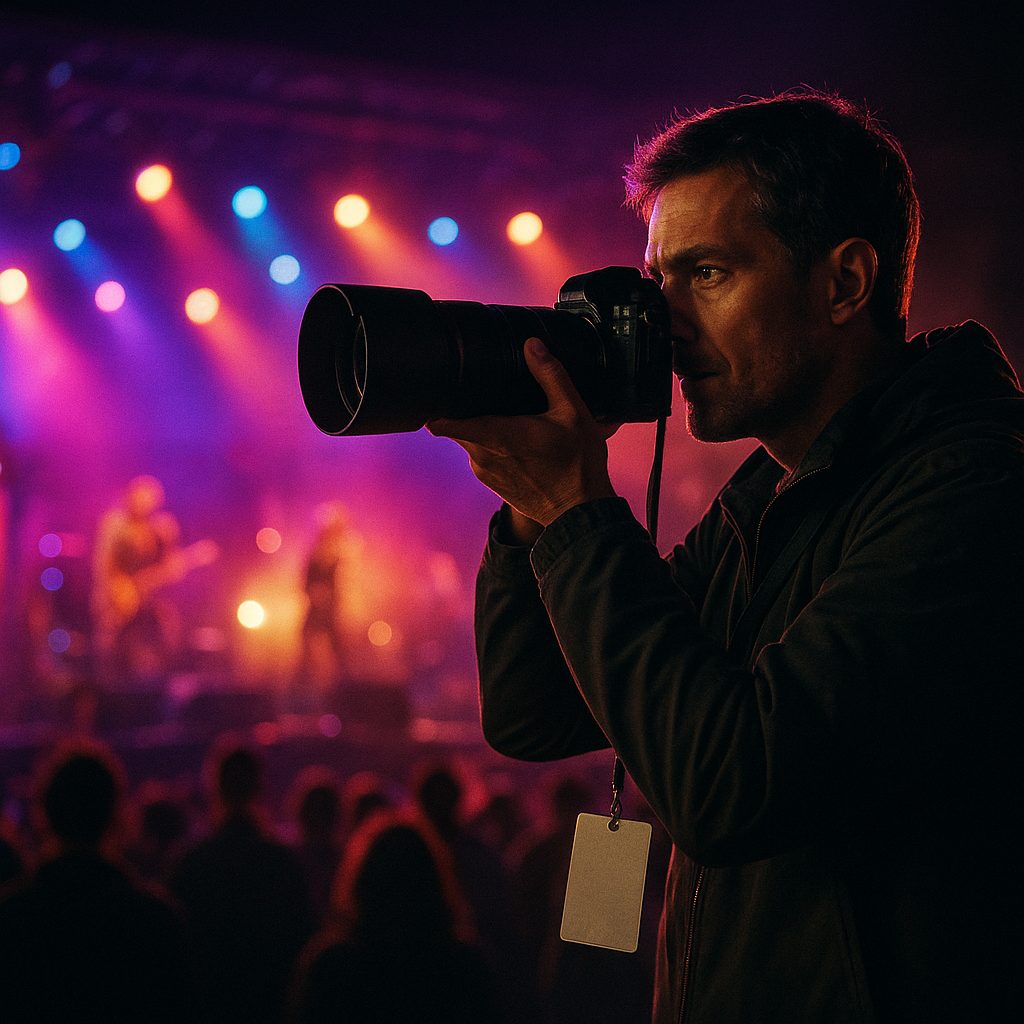
Festival photography is the genre where everything happens at once: light that changes every thirty seconds, subjects who will never repeat a gesture, twelve hours on your feet and a deadline tomorrow morning. It is also one of the most enjoyable ways to hold a camera. Whether you are shooting a music festival's main stage or the crowds of a photography festival itself, the working principles are the same — access, preparation, fast technique and honest behaviour in a field full of strangers.
Access comes before everything
At any organised festival, the first question is not which lens but which pass. Professional and semi-professional cameras are routinely restricted for general attendees, so if you want to work seriously, apply for press accreditation — usually weeks in advance, through the festival's media page, with a portfolio link and a letter from whoever will publish the work. Smaller festivals are often glad to credential committed photographers from local outlets or their own volunteer media teams; volunteering for the festival's official coverage is a legitimate and underrated way in. Read the accreditation terms: many events claim usage rights over photos made on their pass, and you should know exactly what you are signing before the first note sounds.
Pack for twelve hours, not for a catalogue
The classic festival kit is lean: one or two bodies and fast zooms covering wide to short telephoto — the 24–70mm f/2.8 and 70–200mm f/2.8 pair exists because generations of event photographers settled the argument. Add a fast prime for after dark if your bag allows. Batteries and cards are the real consumables: carry double your pessimistic estimate, because there is no shop inside the fence. Beyond cameras: earplugs rated for concerts (non-negotiable near a PA), a rain cover that costs almost nothing and saves everything, a monopod if you shoot long glass for hours, and a comfortable strap system — your shoulders file the first complaint of the day and the loudest.
Settings for impossible light
Stage light is the hardest common lighting situation in photography: extreme contrast, colours that sweep from deep red to blown white, and brightness that changes within a single song. Shoot raw, always. A workable starting point is manual exposure with auto ISO: shutter at 1/250th or faster to freeze performers, aperture near wide open, and let ISO float with a ceiling you have tested on your own sensor. Meter for the highlights and accept crushed shadows — stage pictures live in the lit faces, and shadow noise lifts far better than blown skin recovers. When the light turns deep red or blue, expose for the performer's face and let the atmosphere be atmosphere.
In the crowd, the problems invert: harsh midday sun, then near-darkness after sunset. A small flash balanced as gentle fill can rescue backlit faces in daylight; after dark, high ISO and fast lenses do the work, and the stage glow becomes your light source.
Anticipate instead of chasing
The pit gives you three songs, typically — sometimes less — so the preparation happens before the artist walks on. Study the stage layout, watch the lighting director's habits during the earlier acts, and know which moments tend to arrive: the leap on the final chorus, the walk to the stage edge, the confetti cue at the closer. Position for the background as much as the subject; a clean backdrop at a festival is a rare treasure and worth rearranging your feet for. Shoot the peaks, but shoot the spaces between them too — the quiet second when a performer laughs at a missed cue often outlives the jump shot. And when your three songs end, leave the pit promptly; the photographers who linger past their slot are the reason the next festival's rules get stricter for everyone.
The crowd is half the story
Editors buy stage pictures, but they remember crowd pictures: the faces in the front row, the flags, the stranger asleep on another stranger's shoulder at 2 a.m. Work the audience with the same intent you bring to the stage — look for gesture, light and small human narratives. This is street photography wearing a wristband, and everything about working a scene and reading light in our street photography tips piece transfers directly, just at higher volume.
Ethics in a field of strangers
Festivals lower guards — that is their point — which raises yours. People at festivals are dancing, grieving, celebrating and occasionally having the worst day of their year, all in public and all photographable. Visible distress, medical situations and people too intoxicated to meaningfully consent are not material, whatever the light is doing. Photograph joy freely, photograph vulnerability carefully, and remember that "in public" and "fair game" are different sentences. The fuller framework is in our piece on street photography ethics, and it applies with extra force when your subjects are at their most unguarded.
Deliver like a professional
Festival work lives or dies on turnaround. If you are on assignment, agree the delivery schedule before the event — first selects during the show, full edit within a day or two — and build a culling workflow fast enough to honour it: rate ruthlessly in a first pass, edit only the survivors, caption with names and dates while memory is fresh. Back up every night, twice, in two physical places; cards fail and tents are not safes, and a lost festival shoot cannot be reshot. If you are building toward this kind of work, an event-focused photography workshop is a controlled environment to learn the reflexes, and once your festival portfolio holds together, a well-chosen photography competition in a documentary or music category is a sensible next door to knock on.
Field note. Accreditation terms vary wildly between festivals — some claim broad usage rights over anything shot on their pass. Read them before you shoot, negotiate where you can, and never assume last year's terms survived into this one.